What Happened
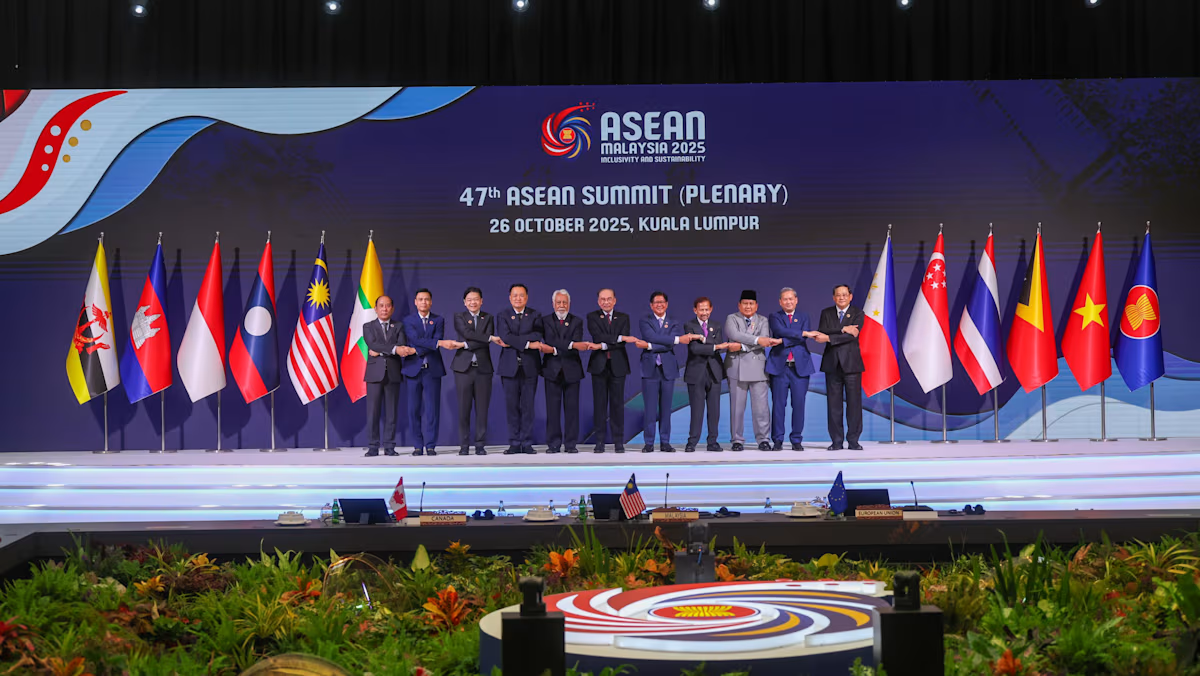
During the opening ceremony of the 47th ASEAN Summit in Kuala Lumpur on 26 October 2025, RTM broadcast a live telecast in which at least three regional leaders were incorrectly identified. Specifically:
- Singapore’s Prime Minister Lawrence Wong was mistakenly called by his predecessor, Lee Hsien Loong.
- Indonesia’s President Prabowo Subianto was misnamed as his predecessor Joko Widodo.
- Thailand’s Prime Minister Anutin Charnvirakul was referred to as former PM Srettha Thavisin.
Following the broadcast errors, RTM issued formal apologies in Malay via its social-media channels. The broadcaster stated that it “viewed the matter seriously” and that “appropriate action has been taken”.
According to RTM’s director-general, both Singapore and Indonesia had accepted the apology. The Singapore and Indonesian authorities reportedly conveyed that they regarded the matter as closed following RTM’s apology.
Why It Matters
While the error may on its face seem minor (names mis-attributed), it touches on several significant issues:
1. Diplomatic protocol and respect. In official international settings such as the ASEAN Summit, correct identification of leaders is vital. Mistakes can be perceived as undermining respect for the individual, the office, and both host and participant countries.
2. Media credibility and broadcasting standards. RTM’s errors raise questions about editorial controls, fact-checking, live-broadcast preparation and staff training. The broadcasting authority in Malaysia will likely face scrutiny for process failures.
3. Regional relations and image. For Malaysia, as summit host and RTM as national broadcaster, the incident risked creating embarrassment or undermining professional standing. For Singapore and Indonesia, the mis-identification could have been interpreted as negligence or disrespect, though both states accepted the apology without escalating.
4. Internal accountability. RTM stated it would increase “editorial control and fact-checking” going forward. This suggests there may be internal discipline or training reforms for the broadcaster.
Therefore, the incident offers a case-study in how live media coverage intersects with diplomacy, protocol and international broadcasting standards.
What RTM Said and How the Apologies Were Handled
After the incident:
- RTM issued two separate statements. One in Malay acknowledged the misidentification of Singapore’s prime minister and Thailand’s prime minister, and a second statement acknowledged a separate error in identifying Indonesia’s president.
- The broadcaster explicitly apologised “to the governments and all affected parties” and pledged to strengthen its processes.
- Malaysia’s Prime Minister’s Department or broadcast regulator did not publicly escalate the matter; instead the broadcaster — not state officials — absorbed responsibility.
- Singapore’s and Indonesia’s authorities reportedly accepted the apology, signalling a preference for resolving the matter through diplomatic channels rather than public protest.
Broader Context: ASEAN, Media and Diplomacy
Live coverage of high-level summits like ASEAN often involves complex coordination of translation, on-screen graphics, commentators and remote feeds. Errors, while rare, can occur under time pressure and imperfect conditions.
However, they are also more consequential when they involve official names and positions. In Southeast Asia’s network of diplomatic relations and multilateral summits, accuracy signals respect and professionalism.
For Malaysia, hosting the summit imposes extra expectations on national broadcasters. For Singapore and Indonesia — regional peers and major participants — the errors may raise concerns about media reliability in cross-border settings. The fact that both states accepted the apology indicates a shared desire to maintain stable relations and keep the incident from becoming a bilateral issue.
Potential Repercussions and Learning Points
Media organisations: RTM will likely review its live-broadcast protocols, perhaps re-training commentators, improving name-verification workflows and deploying playback checks even in live settings.
Diplomatic services: Embassies and foreign ministries may increase advisory guidance to domestic broadcasters when leaders are in international forums, emphasising accuracy in live telecasts.
Host country parliaments and regulators: Malaysia may face calls (though likely limited) from parliamentary oversight committees to assess whether national public-service broadcasters meet required standards during high-profile events.
Audience and public perception: Domestic viewers in Malaysia may perceive the incident as another example of media slip-ups; in Singapore and Indonesia, audiences might view the error as minor but symbolic of larger expectations in regional diplomacy.
What to Watch
- Follow-up reforms at RTM: Will RTM publish an internal review of the incident? Will it announce new training or procedural changes?
- Diplomatic reactions: Although Singapore and Indonesia accepted the apology, will future ASEAN communications stress broadcast accuracy or lead to formal guidelines for summit coverage?
- Media regulatory trends: Malaysia’s broadcast regulator may introduce or reinforce policies on live-event broadcasting training, especially for high-stake diplomatic summits.
- Public and institutional memory: Will the summit’s organisers (ASEAN Secretariat) recommend guidelines or protocols for partner broadcasters to reduce such mistakes in the future?
- Re-emergence of the error: If similar errors occur in subsequent events, that will test whether this incident prompted meaningful change or was treated as an isolated event.
Conclusion
The mis-identification of Singapore’s and Indonesia’s leaders by RTM during the ASEAN Summit may seem like a simple broadcast error. However, by affecting diplomatic protocol, media credibility and regional trust, it assumes greater significance.
Still, the fact that Singapore and Indonesia accepted the apology without further escalation underscores a shared regional preference for harmonious resolution and pragmatic diplomacy. For Malaysia and RTM, it presents an opportunity to strengthen broadcasting standards and reaffirm their commitment to professionalism in international media coverage.
In the end, the incident serves as a reminder: in the interconnected world of live diplomacy, a broadcaster’s slip-up can ripple across borders — but so too can a sincere apology and constructive follow-through.