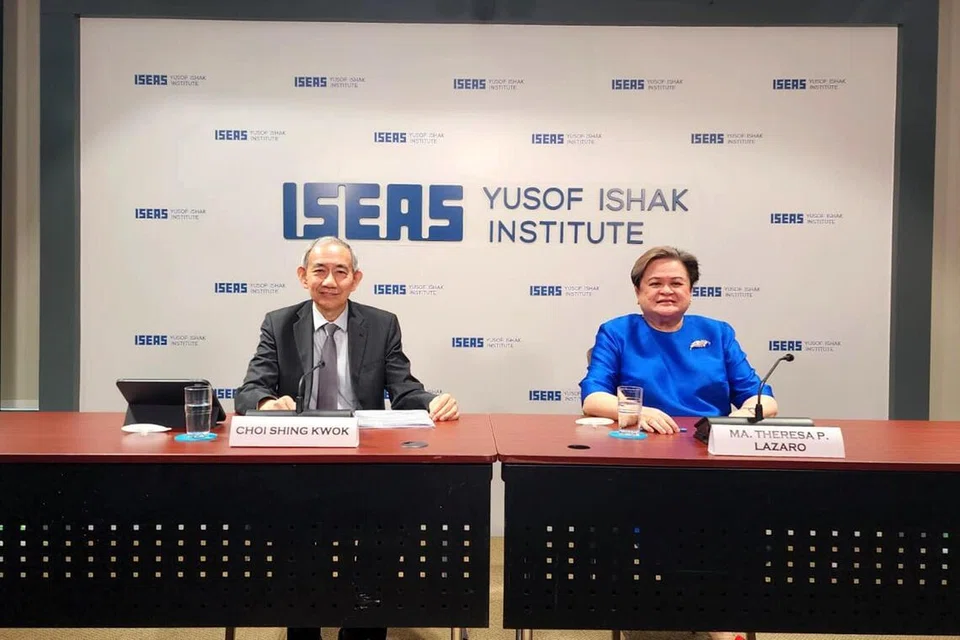
The Association of Southeast Asian Nations will not alter its position on Myanmar, despite persistent questions from diplomats and analysts about whether the regional bloc is softening its stance, Philippine Foreign Secretary Theresa Lazaro said during a public lecture in Singapore.
Speaking at the ISEAS – Yusof Ishak Institute, Lazaro stressed that ASEAN continues to reject recognition of Myanmar’s military-organised election unless violence across the country comes to a halt. She emphasized that the bloc remains anchored to the Five-Point Consensus, the framework agreed shortly after the 2021 coup that outlines ASEAN’s approach to the crisis.
“There is no change,” Lazaro told the audience during a question-and-answer session that was dominated by queries on Myanmar. She said the consensus remains the foundation for ASEAN’s engagement, even as discussions evolve around how humanitarian assistance and diplomatic outreach might be structured.
Five-Point Consensus remains central
The Five-Point Consensus calls for an immediate cessation of violence, inclusive dialogue among all parties, humanitarian assistance, and the role of a special envoy. Lazaro underlined that the first condition – ending violence – remains the most basic and non-negotiable benchmark for any reassessment of ASEAN’s position.
She noted that bombings and armed clashes were still being reported as recently as December 2025, reinforcing concerns that the conditions on the ground have not improved sufficiently to justify recognition of the election outcome.
Myanmar has been engulfed in civil conflict since the military seized power in 2021, triggering widespread resistance, armed conflict, and a deepening humanitarian crisis. Despite these realities, the junta pressed ahead with a general election held in stages between December 2025 and January 2026, a move widely criticised as an attempt to legitimize military rule.
Engagement does not equal endorsement
Lazaro acknowledged that ASEAN discussions have explored “certain permutations,” including proposals to scale up humanitarian aid to Myanmar’s population, many of whom are facing displacement, food insecurity, and limited access to medical care.
She explained that these conversations stemmed from her meetings with a broad range of actors, including the military authorities and non-junta political and ethnic groups. As the ASEAN chair’s special envoy on Myanmar, Lazaro said she sought to hear multiple perspectives ahead of the recent ASEAN Foreign Ministers’ Meeting.
Her early January visit to Naypyitaw, where she met with the military leadership, sparked speculation that ASEAN might be recalibrating its approach. Lazaro addressed those concerns directly, saying dialogue should not be mistaken for endorsement and that engagement was necessary to fully understand the evolving situation.
Outreach beyond the junta
Two weeks after her Naypyitaw visit, Lazaro convened a separate stakeholders’ meeting in Tagaytay City in the Philippines, bringing together representatives from various Myanmar political and ethnic groups. She described these engagements as essential, particularly given that some stakeholders have not been meaningfully included in diplomatic efforts for years.
She said ASEAN must continue meeting groups outside the military establishment, even as the junta claims conditions could improve following the election. According to Lazaro, maintaining contact with a wide spectrum of voices is crucial to any credible path forward.
No consensus on election recognition
The question of whether ASEAN would endorse Myanmar’s election surfaced prominently during the ASEAN Foreign Ministers’ Retreat held in Cebu City on January 29, which marked the opening phase of the Philippines’ 2026 chairmanship.
Lazaro said there was no consensus among member states “for now” to recognize the vote. Several countries expressed skepticism, viewing the election as falling short of international standards and failing to reflect genuine political inclusion.
Her remarks in Singapore suggested that while some ASEAN members may favor more pragmatic engagement with the junta, the bloc as a whole is not prepared to abandon its established principles.
Call for longer-term envoy
To strengthen continuity, Lazaro proposed appointing a longer-term ASEAN special envoy on Myanmar rather than rotating the role annually with the chairmanship. She argued that a sustained mandate could help maintain momentum, institutional memory, and trust across complex negotiations.
Such a move, she suggested, could improve ASEAN’s ability to navigate what she described as an “evolving issue,” particularly as the crisis shows no immediate signs of resolution.
Broader regional agenda continues
While Myanmar dominated much of the discussion, Lazaro also highlighted other priorities under the Philippines’ ASEAN chairmanship. She said there is renewed momentum within the bloc to advance negotiations with China on a long-delayed Code of Conduct for the South China Sea, an issue that remains critical to regional stability.
Her comments underscored that ASEAN faces a crowded and challenging agenda in 2026, balancing geopolitical tensions, humanitarian crises, and internal divisions while attempting to preserve unity and credibility.