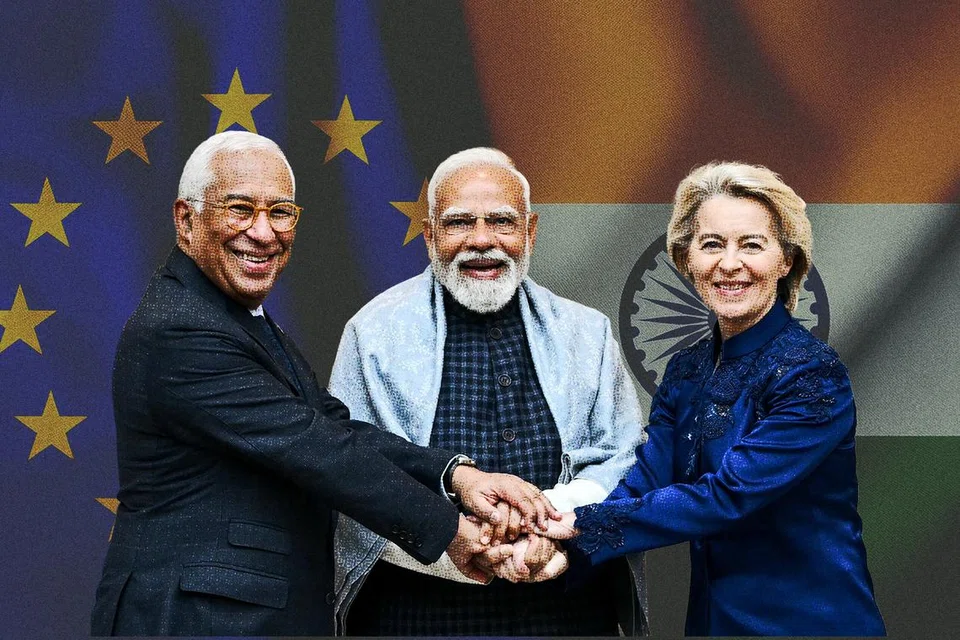
India has moved decisively onto the global trade stage, unveiling a series of high-profile agreements that signal a shift in both economic ambition and geopolitical posture. A landmark free trade agreement with the European Union, followed swiftly by a framework arrangement with the United States that eases tariff pressures on Indian exports, reflects more than commercial pragmatism. Together, these deals illustrate how New Delhi is recalibrating its global strategy in a world defined by shifting alliances and economic competition.
In a recent discussion on The Straits Times’ regional affairs podcast, senior columnist Ravi Velloor explored the broader implications of these agreements with Ambassador Jawed Ashraf, Chairman of the India Trade Promotion Organisation and a former foreign policy aide to Prime Minister Narendra Modi. With diplomatic postings in Singapore and France, Ashraf offered insight into the motivations guiding India’s renewed embrace of market-opening trade frameworks.
A Shift from Caution to Confidence
For years, India was perceived as hesitant about deep trade liberalisation. Its withdrawal from the ASEAN-backed Regional Comprehensive Economic Partnership (RCEP) in 2019 reinforced the narrative that New Delhi preferred protective policies over sweeping regional trade commitments.
However, the new agreements suggest a significant change in outlook. The comprehensive trade pact with the European Union has been described as transformative, setting new benchmarks in regulatory alignment, market access, and investment protection. Meanwhile, the framework arrangement with Washington includes reductions in punitive tariffs that had previously placed Indian exporters at a disadvantage compared to regional competitors such as Vietnam and Malaysia.
Ambassador Ashraf pointed to a growing sense of economic maturity and resilience within India. The country’s expanding manufacturing base, digital economy growth, and infrastructure improvements have given policymakers greater confidence to negotiate ambitious trade arrangements without fear of domestic disruption.
Strategic Calculations in a Multipolar World
India’s renewed trade activism cannot be separated from broader geopolitical dynamics. The European Union itself is adjusting to a multipolar global order, seeking reliable economic partners as it balances relations with both the United States and China. For Brussels, deeper trade integration with India represents not only economic opportunity but also strategic diversification.
From India’s perspective, closer ties with the EU strengthen its position as a key democratic partner in global supply chains. Quality trade agreements also create a framework for stronger foreign direct investment flows, enhancing India’s appeal as an alternative production hub.
Similarly, the U.S.-India framework agreement reflects shared interests beyond tariffs. While the headline development was the reduction of U.S. duties on Indian exports, the broader context includes technology cooperation, supply chain resilience, and shared concerns over global economic stability.
Ashraf suggested that these agreements are as much about positioning as they are about market access. By engaging simultaneously with Washington and Brussels, India signals its willingness to anchor itself firmly within global economic governance structures while maintaining strategic autonomy.
Revisiting RCEP: Possibility or Pragmatism?
The question of whether India might reconsider its withdrawal from RCEP remains central to regional trade discussions. RCEP, backed by ASEAN and including China, Japan, South Korea, Australia, and New Zealand, is one of the world’s largest trade blocs.
While India has kept the door technically open for future engagement, Ashraf indicated that immediate re-entry appears unlikely. Domestic concerns over trade imbalances and industry competitiveness persist, particularly regarding China.
Nonetheless, India has shown signs of recalibrating its relationship with Beijing in carefully measured ways. Trade flows between the two countries remain significant, and there are indications of a more pragmatic tone in economic engagement even as political tensions endure.
Rather than rushing back into RCEP, India appears focused on building confidence through bilateral and smaller multilateral arrangements. The strategy prioritises securing favourable terms and strengthening domestic industries before contemplating broader regional commitments.
Trade as a Foundation for Strategic Partnerships
Beyond tariffs and quotas, these agreements underscore how modern trade deals increasingly function as instruments of diplomacy. Provisions covering digital trade, intellectual property, sustainability standards, and regulatory harmonisation serve to align economic systems more closely.
Ashraf highlighted that comprehensive trade frameworks often precede deeper political and strategic partnerships. As supply chains become more integrated, mutual dependencies can translate into greater diplomatic coordination.
India’s approach suggests an understanding that economic strength enhances geopolitical leverage. By expanding trade networks with key global players, New Delhi increases its influence while diversifying economic risk.
The Confidence Factor
A defining feature of India’s recent trade momentum is its evolving self-perception. Rapid economic growth, a burgeoning technology sector, and demographic advantages have bolstered confidence among policymakers. Rather than viewing trade liberalisation as a vulnerability, leaders now increasingly frame it as an opportunity to scale up India’s global presence.
The European Union agreement, in particular, reflects this mindset. By committing to higher standards and broader access, India signals that it sees itself as ready to compete at the highest levels of global commerce.
Meanwhile, the U.S. framework deal demonstrates tactical pragmatism. Securing tariff reductions helps Indian exporters remain competitive while reinforcing political ties at a time when global supply chains are under scrutiny.
Balancing Autonomy and Integration
India’s trade recalibration also highlights its longstanding pursuit of strategic autonomy. Even as it signs ambitious agreements with Western partners, New Delhi remains cautious about binding commitments that could constrain domestic policy flexibility.
This balancing act is evident in its measured stance toward China and RCEP. India seeks to remain integrated with global markets without surrendering the ability to safeguard sensitive sectors.
By pursuing diversified partnerships rather than relying heavily on any single bloc, India positions itself as a pivotal actor capable of navigating complex global dynamics.
The flurry of agreements announced in recent weeks thus reflects not just economic necessity but a broader strategic vision. Trade has become a central pillar in India’s bid to consolidate its status as a major global power, reinforcing alliances while maintaining independent decision-making authority.