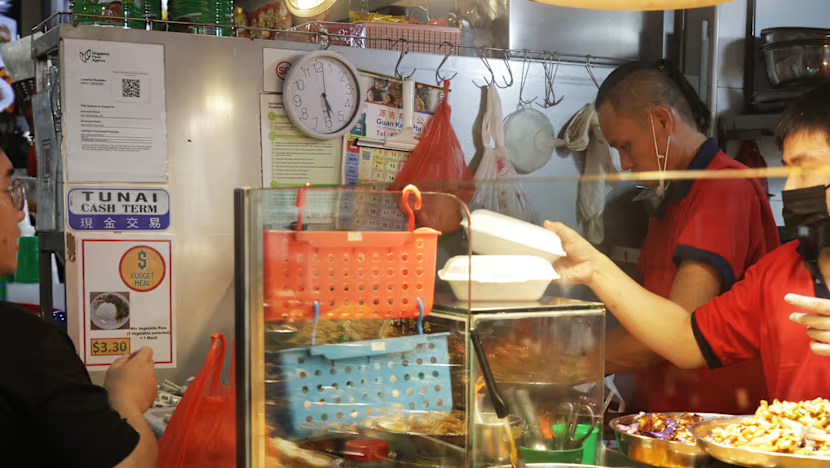
Coffee shop operators in Singapore have welcomed changes to the budget meal initiative, which will now allow more flexibility and help make the scheme more sustainable. From January 10, 2026, coffee shops operating under Housing and Development Board (HDB) tenancies will no longer be required to offer budget meals at tenancy renewal. Privately owned coffee shops also have the option to opt out of the scheme immediately.
This shift gives operators the ability to decide whether to participate in the budget meal scheme, in exchange for more substantial discounts on rent or Temporary Occupation Licence (TOL) fees. Alongside this, HDB has simplified and standardized the meal offerings, reducing the options from two to six choices to just three fixed meals: an economy rice option, a halal meal, and a breakfast dish. The requirement to provide two budget drinks priced at around S$1.20 remains unchanged.
New Standardized Requirements for Budget Meals
The changes to the budget meal initiative aim to bring greater clarity and consistency to the program. Mr. Hong Poh Hin, chairman of the Foochow Coffee Restaurant and Bar Merchants Association, emphasized that the new standardization will help operators define what constitutes a “budget meal” more clearly. Previously, ambiguity around meal definitions led to challenges for coffee shops, especially when providing low-profit, limited menu options.
The three standardized meal options now include a basic economy rice meal (rice with one meat dish and two vegetable dishes), a halal meal, and a breakfast choice. This simplification allows operators to more easily align with the scheme’s requirements and manage their offerings effectively.
Extended Rent Discounts: A Mixed Blessing for Coffee Shop Owners
As part of the revised scheme, the 5% rent discount provided to rental coffee shops for participating in the budget meal program will now be extended over the full three-year term of the tenancy, instead of just one year as it was previously. This change is welcomed by operators like Mr. Hong, who owns a coffee shop in Serangoon. He believes the extended discount will help offset rising operational costs, especially given that rental fees are a significant part of a coffee shop’s overheads.
“Now they added another two years (of discounts)… So this is an additional benefit to the operator,” Mr. Hong said, highlighting how these incentives could encourage more participation in the scheme.
However, some operators remain cautious. Glenn Koh, managing director of coffee shop chain De Tian, acknowledged that while the discounts would help reduce operating costs, they may not fully cover the expenses of running a coffee shop. He noted that each outlet’s financial situation is different, and the discounted rent alone might not be enough to make up for the low-profit margins on budget meals.
Ongoing Challenges: Drink Pricing and Halal Meal Requirements
Despite the benefits, coffee shop operators still face significant challenges under the revised budget meal scheme. One concern voiced by Mr. Koh is the difficulty in maintaining profitability with the pricing of drinks. Under the current model, customers who order the budget drink option pay a fixed price of S$1.20 for either tea or coffee. For many operators, this pricing leaves slim profit margins on beverages, which are typically a core source of income.
Additionally, fulfilling the halal meal requirement could pose operational hurdles. Mr. Koh suggested that one solution might be to partner with a halal-certified Western stall to provide the halal meal option, but this adds complexity to operations and costs.
Moreover, the rise in competition from a growing number of Chinese cuisine stalls, along with a decline in foot traffic at coffee shops due to increased travel, has put additional strain on operators. “All these added competition, that’s our challenges,” Mr. Koh remarked, reflecting the pressure the industry is facing as it adapts to changing consumer preferences and market dynamics.
Looking Ahead: A More Flexible Future for Coffee Shops
As coffee shop operators navigate these changes, many are optimistic about the flexibility the new budget meal scheme offers. However, they remain cautious about the ongoing challenges, including pricing pressures, the halal meal requirement, and increasing competition. The hope is that with continued support and adaptability, coffee shops can find a way to thrive in an evolving market while meeting the needs of their customers.