Funded by businessman Dr. Hamis Kiggundu and endorsed by President Yoweri Museveni, the overhaul of the city’s main drainage trench has become a high stakes experiment in locally financed infrastructure, stirring praise, suspicion and a debate over who really benefits when private money rebuilds public space.
KAMPALA, Uganda — For more than half a century, the Nakivubo Channel has carved across the centre of Uganda’s capital as both a necessity and a hazard. Conceived as the city’s primary stormwater artery, the trench was meant to guide runoff from the surrounding hills toward Lake Victoria. Instead, it evolved into a choked, foul-smelling open drain that overflowed with almost every heavy rain, leaving markets submerged, roads impassable and businesses counting their losses.
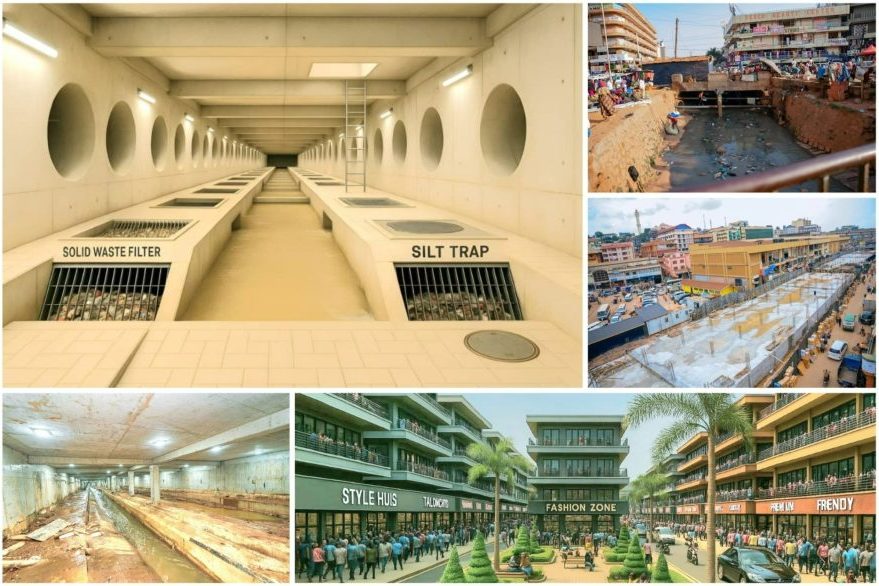
Today, the same channel is the subject of one of the most ambitious and controversial urban redevelopment efforts in Kampala’s recent history — a privately financed project by businessman Dr. Hamis Kiggundu aimed at transforming the open drain into an engineered underground waterway topped with structured commercial developments. The plan is backed by President Yoweri Museveni, scrutinised by environmentalists, contested by city politicians and watched closely by traders who live with the consequences of every storm.
The clash surrounding Nakivubo is no longer simply about a drainage line. It has become a test of urban governance: who decides how a city is reshaped, how public assets are managed and what role private capital should play when the state’s resources fall short.
A Channel That Became a Problem Too Big to Ignore
By the early 2000s, Nakivubo had become a symbol of Kampala’s longstanding infrastructure challenges. Its concrete bed cracked, its walls collapsed and its cross-section narrowed as informal settlements and commercial structures encroached along its banks. Tonnes of plastic waste gathered in its waters; upstream pipes trapped debris; and the wetlands that once filtered wastewater and stormwater shrank dramatically.
Rainstorms turned the central business district into a predictable disaster zone. St. Balikuddembe Market, Kikuubo, Clock Tower, and low-lying roads regularly flooded. Traders hoisted goods onto shelves or evacuated shops. Vehicles stalled in deep water. Kampala Capital City Authority (KCCA) noted repeatedly that the drainage system was “heavily clogged” and operating far below capacity.
Yet despite detailed engineering assessments, limited municipal funding and competing political interests left structural intervention delayed for years.
Into that gap stepped an unlikely force: private capital.
The Stadium That Triggered a Larger Conversation
The turning point came with the redevelopment of Nakivubo War Memorial Stadium, an aging public facility that government handed over to Dr. Kiggundu for refurbishment. His companies, Ham Enterprises and later KIHAM Enterprises (U) Ltd, undertook a multi-year renovation, building a modern sports and commercial complex that now towers over downtown streets.
International football inspectors from CAF and FIFA praised the upgraded stadium but flagged the surroundings. The open drainage trench adjoining the stadium posed serious hygiene and safety concerns. They noted restricted access, waste accumulation and congestion — all factors that could affect Uganda’s readiness to co-host the 2027 Africa Cup of Nations.
To meet those international standards, the environment outside the stadium would require as much attention as the facilities inside.
Ham’s team began with basic yet transformative work: unclogging underground conduits, removing debris, and improving water flow. The impact was immediate. When a major downpour hit the city in March 2025, many districts flooded, but the vicinity of the stadium — recently desilted — remained unusually dry.
Instead of paving the way for deeper cooperation, the incident set off a political fight.
A Dispute Between an Investor and City Hall
KCCA, under Lord Mayor Erias Lukwago, halted the ongoing drainage works, insisting the investor lacked proper approval. Ham’s engineers argued that KCCA’s technical division had already vetted and stamped the initial plans. Documents backing this claim later appeared in Council discussions.
What began as a regulatory disagreement grew into a broader struggle over authority. City Hall accused the investor of overstepping legal boundaries. Supporters of the project accused the political leadership of blocking solutions to a longstanding problem for partisan reasons.
After on-site inspections and meetings, KCCA softened its stance. In December 2024, the Physical Planning Committee approved the drainage works, acknowledging the clogged channel and the need for urgent intervention. But when Ham submitted a more comprehensive proposal in February 2025 to widen, cover and redevelop the channel under Application No. KCCA2425000004692, the process stalled.
For months, the application remained unanswered.
A Presidential Directive Changes the Landscape

On July 25, 2025, Dr. Kiggundu wrote directly to President Museveni, presenting a detailed plan to rehabilitate the drainage, cover it with a reinforced concrete slab and construct commercial blocks above it to recover investment costs.
Within a week, the President issued a directive approving the concept and instructing the Prime Minister to ensure its implementation. He described the project as “a godly proposal,” arguing that covering the channel would stop waste dumping, reduce flooding and improve public health.
The directive changed everything. Ministries moved swiftly, KCCA was instructed to cooperate, and preliminary works commenced — including clearing, fencing and unblocking the flow path. On September 9, 2025, KCCA issued formal planning approval for the redevelopment, subject to technical conditions.
For supporters, the directive reflected an overdue willingness to tackle a major urban hazard. For critics, it raised concerns about process, precedent and the blurred lines between public planning and presidential authority.
Environmental Scrutiny and Parliamentary Attention
Environmentalists questioned whether covering the entire channel was advisable without broader reforms in sewage management and wetland restoration. Nakivubo, they pointed out, is part of a wider ecological system that historically served as both a sponge and a filter. Replacing its open surface with concrete could remove its remaining ecological function.
Policy analysts warned about governance risks. When an investor secures political endorsement before regulatory review, they said, institutions like KCCA and the National Environment Management Authority (NEMA) may face pressure to conform rather than evaluate independently.
Parliament briefly intervened when COSASE summoned officials and the investor over alleged irregularities. Days later, the matter was reassigned to the Committee on Physical Infrastructure, which visited the site and publicly praised the work for its engineering scope, employment generation and potential urban benefits.
On October 3, 2025, NEMA issued a Certificate of Approval for the Environmental and Social Impact Assessment, attaching conditions for mitigation and monitoring.
With environmental clearance, political backing and planning approval, the project advanced to its most visible phase.
Then Came the Floods
On October 31, 2025, heavy rains battered Kampala for four straight hours. Arcades in downtown flooded severely, with water rising high into commercial buildings. Traders suffered devastating losses. Anger spread quickly.
Lord Mayor Lukwago blamed the floods on the ongoing redevelopment works and demanded that the investor compensate traders. Supporters of the project countered that the same arcades had experienced similar floods in 2019 — long before the redevelopment began — and that the real culprits were decades-old undersized culverts, blocked inlets and a chronically overloaded drainage network.
Prime Minister Robinah Nabbanja intervened, touring the damaged arcades and the Nakivubo site. She instructed engineers to widen inlets and culverts and clear pathways to allow stormwater to reach the channel more efficiently. She also acknowledged that sections of the channel had already been widened from six to twelve meters and encouraged coordinated technical support across agencies.
The floods reframed the debate. They revealed the extent of Kampala’s underlying drainage weaknesses and raised the stakes of the ongoing redevelopment — turning it from a political dispute into a question of urban survival.
Competing Visions for a Modern Kampala
Supporters of the project argue that the redevelopment represents a practical, locally financed intervention in a city where public infrastructure budgets are perpetually overstretched. They cite early improvements in water flow, potential job creation and the opportunity to modernize the area ahead of AFCON 2027.
They also emphasize safety. The open trench, they note, has long been a crime corridor where thieves escaped through the drainage. Covering it could eliminate that hazard.
Local economists highlight broader impacts: increased property values, expanded municipal tax revenue and improved traffic circulation.
Environmentalists and civil society groups see a different picture. They caution against sealing an ecologically significant waterway without addressing upstream waste disposal, wetlands depletion and citywide sanitation deficits. They warn that engineered channels can fail if maintenance declines or if rainfall patterns grow more extreme under climate change.
Some critics question the concentration of control in private hands. If the city’s primary drainage line is redesigned and built by a single investor, they ask, what precedent does that set for other public assets?
Between these positions lies a more urgent reality: the daily lives of traders and residents who endure the floods and stench. For them, the debate is less ideological than practical. They want streets that do not flood and markets where goods remain safe.
What Happens Next
As of late 2025, the Nakivubo project remains in progress. The channel has been widened and partially re-engineered. Construction of commercial blocks is planned above a reinforced slab. NEMA’s conditions require ongoing monitoring. KCCA is responsible for oversight. Parliamentary committees continue to observe related issues. And the President remains vocal in his support.
The success of the redevelopment rests on several factors:
• whether enforcement of waste disposal improves;
• whether wetlands further upstream are protected or restored;
• whether culverts and inlets are expanded citywide;
• whether engineering designs withstand increasingly intense storms;
• and whether oversight remains independent, consistent and transparent.
Nakivubo Channel is no longer just a drainage trench. It is a case study in how a modern African city grapples with climate risk, political power, private capital and the weight of its own infrastructural history.
As Kampala moves forward with the Nakivubo redevelopment, its success will rest on the quality of decisions made in boardrooms, ministries, and on the ground, shaping how the city prepares for the storms ahead. For now, the channel continues to run through the heart of the capital, carrying not only the water from its hills but the momentum of a city attempting to build a more resilient future.