Singapore’s secondary private housing market weakened further in the first quarter of 2026, with resale transactions falling 9.6% quarter-on-quarter as buyers increasingly shifted toward newly launched residential projects.
According to a report by Savills Research, the decline marked the second consecutive quarterly contraction in Singapore’s secondary home sales market following an earlier 8.7% drop in the fourth quarter of 2025.
The downturn reflects broader cooling activity across the city-state’s property market amid:
- Softer buyer demand
- Reduced resale supply
- Fewer housing completions
- Growing competition from primary market launches
Singapore’s Resale Housing Market Loses Momentum
The latest data shows Singapore’s secondary residential market continues struggling to regain the momentum seen during the post-pandemic property rebound.
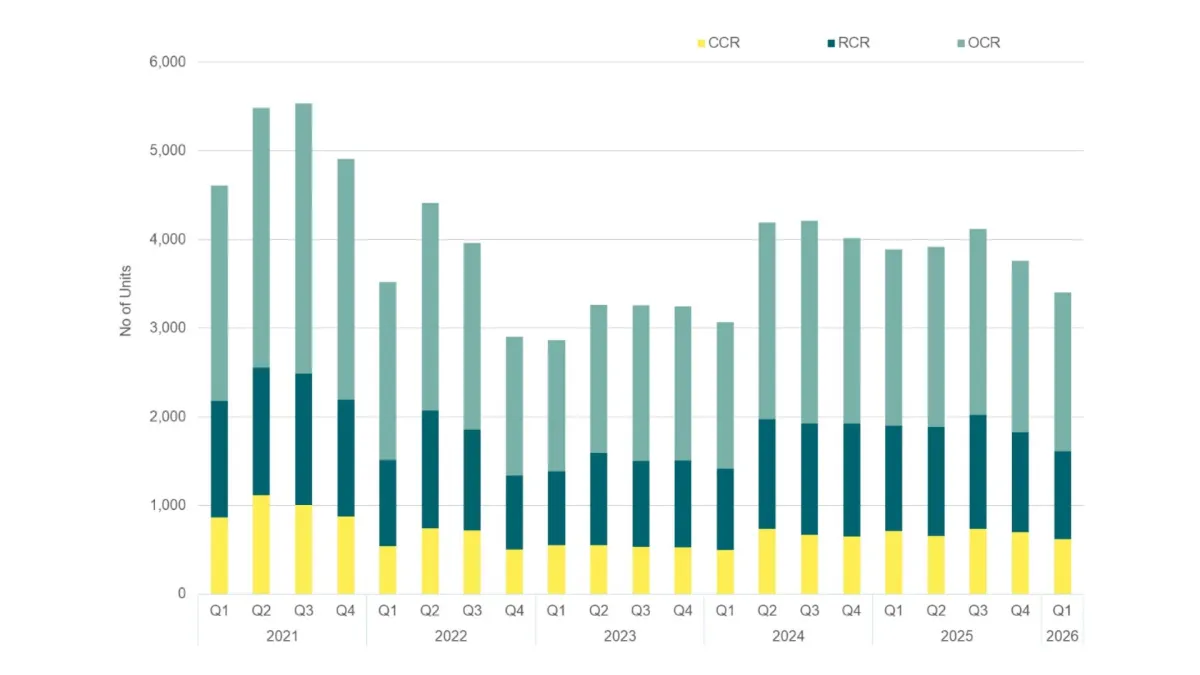
Secondary home sales had previously peaked between:
- Q2 and Q3 2021
when transaction volumes exceeded:
- 5,000 units quarterly
However, volumes weakened sharply throughout:
- 2022
- 2023
before partially recovering in:
- Q2 and Q3 2024
when quarterly transactions again surpassed:
- 4,000 units.
Market activity stabilized somewhat during 2025 before weakening again in early 2026.
Buyers Shift Toward New Launches
One of the biggest drivers behind the resale slowdown has been growing demand for:
- Primary residential launches
Developers have increasingly introduced new projects that attract buyers with:
- Modern amenities
- Flexible payment structures
- Promotional incentives
- Newer facilities
- Energy-efficient features
This has diverted some purchasing activity away from older resale units.
The report suggests many buyers now prefer:
- Newly completed condominiums
- Integrated developments
- Newly launched suburban projects
despite higher pricing in some segments.
Core Central Region Records Sharpest Decline
The:
- Core Central Region (CCR)
recorded the steepest quarter-on-quarter decline among Singapore’s three key market segments.
Resale transactions in the CCR fell:
- 11.7% to 616 units
The segment includes many of Singapore’s:
- Prime luxury districts
- High-end condominiums
- Central business area residences
The Q1 performance represented the lowest resale volume for the CCR since:
- Q1 2024
when only:
- 499 units
were transacted.
Rest of Central Region Also Weakens
The:
- Rest of Central Region (RCR)
also experienced significant contraction.
Transactions declined:
- 11.4% to 996 units
This marked the segment’s weakest quarterly resale performance since:
- Q1 2024
when volumes reached:
- 913 units.
The RCR typically includes:
- City fringe properties
- Mid-tier condominiums
- Popular suburban-adjacent districts
which are often highly competitive among owner-occupiers and investors.
Outside Central Region Remains Most Active
The:
- Outside Central Region (OCR)
continued accounting for the largest share of secondary transactions despite slowing activity.
Sales in the OCR declined:
- 7.7% to 1,788 units
from:
- 1,937 units in the previous quarter.
Even with the decline, the OCR remained more resilient than other segments because of:
- Lower entry prices
- Greater affordability
- Stronger mass-market demand
Savills noted that buyers continue viewing suburban projects as relatively attractive compared with rising prices in newly launched developments.
Affordability Becoming Bigger Market Factor
Affordability concerns increasingly influence buyer decisions across Singapore’s housing market.
Higher financing costs, elevated property prices, and cautious economic sentiment have pushed many buyers toward:
- Smaller units
- Suburban properties
- Lower-priced resale homes
At the same time, new launches in central areas have become increasingly expensive, further limiting accessibility for some buyers.
The affordability gap between:
- Prime properties
- Mass-market suburban housing
continues widening.
Singapore Property Market Facing More Balanced Conditions
The latest data may signal a broader normalization within Singapore’s residential property market after years of strong post-pandemic growth.
Government cooling measures, higher borrowing costs, and tighter financing conditions have all contributed to:
- Moderating demand
- Slowing speculative activity
- Stabilizing transaction volumes
Singapore authorities have repeatedly emphasized the importance of:
- Sustainable housing growth
- Financial stability
- Controlled property inflation
Supply Constraints Also Affecting Resale Activity
The report also highlighted reduced resale inventory and fewer home completions as contributing factors behind weaker transaction volumes.
Limited resale supply can restrict market activity because:
- Buyers face fewer choices
- Sellers hold properties longer
- Competition intensifies for available units
At the same time, developers continue prioritizing new launches in strategic locations, pulling more demand into the primary market.
Investors Continue Watching Singapore Closely
Despite the slowdown, Singapore remains one of Asia’s most closely watched residential property markets because of:
- Political stability
- Strong legal framework
- High-income economy
- International investor demand
- Limited land supply
The city-state continues attracting:
- Foreign investors
- Regional wealth
- Institutional capital
- Family office investments
especially in premium residential districts.
Luxury Segment Facing More Caution
The sharper decline in the:
- Core Central Region
may also indicate increasing caution within the luxury market.
High-end buyers are becoming more selective amid:
- Global economic uncertainty
- Geopolitical tensions
- Interest rate volatility
- Wealth preservation concerns
Luxury property activity remains highly sensitive to:
- International capital flows
- Currency movements
- Investor confidence
Singapore’s Housing Market Still Structurally Strong
While transaction volumes weakened, analysts continue viewing Singapore’s long-term property fundamentals as relatively resilient because of:
- Limited land availability
- Population growth
- Strong infrastructure
- Stable governance
- Regional financial hub status
The market slowdown currently appears more linked to:
- Demand moderation
- Buyer caution
- Market rebalancing
rather than systemic weakness.
Frequently Asked Questions
How much did secondary home sales fall in Singapore?
Secondary private residential sales fell 9.6% quarter-on-quarter in Q1 2026.
Which market segment declined the most?
The Core Central Region recorded the largest decline at 11.7%.
Why are resale transactions weakening?
Factors include:
- Weaker buyer demand
- Shift toward new launches
- Reduced resale supply
- Higher property prices
Which segment remains most active?
The Outside Central Region continues recording the highest transaction volumes.
Is Singapore’s property market weakening overall?
The market is moderating after strong post-pandemic growth, but long-term fundamentals remain relatively stable.
Conclusion
Singapore’s secondary residential property market entered 2026 on a weaker footing as softer buyer demand, limited resale supply, and competition from new launches continued weighing on transaction activity.
While the decline reflects a cooling market environment, Singapore’s broader housing sector remains supported by strong structural fundamentals, limited land supply, and continued investor interest.
As affordability pressures and shifting buyer preferences reshape the market, developers, investors, and policymakers will be closely monitoring whether the slowdown signals a temporary adjustment or the start of a longer market recalibration.